News
Ayni Gold Weekly Briefing: Cooler Inflation Gives Gold Room to Advance
Gold ended last week at a higher level, although the route there was uneven. Softer US inflation, weaker consumer data and a modest decline in the dollar reduced the case for another near-term Federal Reserve rate increase. Bullion benefited, then gave back part of its advance as traders took profits and oil prices revived some concern about future inflation.
The balance of evidence changed more decisively. A weak July employment report had already challenged the case for tighter policy. Last week’s consumer and producer price data reinforced that challenge, giving gold a more supportive macro backdrop.
Gold and Macro Brief
Inflation data changed the policy calculation
US consumer prices rose 0.1% in July and 3.4% over the previous 12 months, according to the Bureau of Labor Statistics. Core CPI, which excludes food and energy, increased 0.2% during the month and 2.5% year over year.
Producer prices added another piece of evidence. Final-demand PPI was unchanged in July after declining 0.1% in June. Its annual rate slowed to 4.7% from 5.5%. The narrower measure excluding food, energy and trade services still rose 0.6% during the month, leaving some price pressure beneath the softer headline.
Other releases pointed in the same direction. US retail sales fell 0.6% month over month, the largest decline since May 2025, while the University of Michigan’s preliminary consumer-sentiment index dropped to 51 from 55.2. Markets had largely priced out a September Fed hike by the end of the week.
For gold, that combination matters more than any single inflation print. Lower expected policy rates reduce the opportunity cost of holding a non-yielding asset. Softer consumer demand also makes it harder to argue that the economy requires additional restraint.
A late pullback left the weekly gain intact
The LBMA Gold Price PM finished Friday at approximately $4,391 per ounce, up 1.3% for the week. The advance returned gold to positive territory for the year, with a year-to-date gain of roughly 0.5% at the 14 August close.
The price action moved in both directions. Gold rallied after the CPI release and reached its strongest level in more than two months before profit-taking pulled it back. Renewed pressure on Iran and firmer oil prices kept the inflation outlook unsettled. A final Friday Reuters market update put the implied probability of a September rate increase at 31%, down from roughly 55% a week earlier.
Gold finished the week with measured strength. Futures positioning and demand for global gold ETFs increased, according to the World Gold Council. The metal still closed below its 200-day moving average, then near $4,503 per ounce, an area the Council identified as the next significant technical test.
Fresh data will decide whether the base holds
The argument about US monetary policy remains open. Core producer prices stayed firm, oil rose during the week, and the preliminary Michigan survey showed one-year inflation expectations increasing to 4.3%. A renewed energy shock could feed back into inflation and complicate the Federal Reserve’s decision.
Gold therefore enters the next phase with better support and a demanding setup. Further evidence of weaker demand or moderating prices would reinforce the shift in rate expectations. A rebound in inflation, a hawkish reading of the Federal Reserve’s July meeting minutes or another jump in oil would test the new base quickly.
RWA and Tokenization
Coinbase chose a regulated route to global distribution
Coinbase received Financial Services Permission from the Financial Services Regulatory Authority of Abu Dhabi Global Market on 11 August. The approval allows the company to arrange investment deals and provide custody for tokenized securities from a regulated international hub.
Coinbase plans to issue digital securities backed by underlying shares and register them under ADGM oversight. The instruments would combine three roles inside one structure: regulated securities, blockchain-native tokens and assets that can interact with on-chain financial applications.
The substance lies in jurisdiction, custody and issuance rules. These components determine whether an on-chain security can move beyond a technical demonstration and enter a market where institutions can actually hold and use it.
Securitize put operating scale behind the infrastructure story
Securitize’s second-quarter disclosure added evidence from a platform already servicing institutional products. The company reported average tokenized assets under management of $4.3 billion during Q2, $5.3 billion in quarterly transaction volume and 663 active funds. Management said assets managed on-chain had reached approximately $5 billion by the reporting date.
The operational details were more revealing than the headline total. Securitize said transfer agents Computershare and Continental had selected its infrastructure for issuer-sponsored tokenized shares. Its broker-dealer received FINRA approval to custody tokenized securities and support atomic settlement against stablecoins, while BlackRock’s BUIDL fund entered a collateral framework involving OKX and Standard Chartered.
These links show how tokenization reaches scale. Asset issuance needs transfer agents, regulated custody, settlement assets and collateral rules working together. The technology becomes useful when the surrounding institutions can process the same instrument through its full lifecycle.
MUFG went after the settlement bottleneck
On 13 August, Mitsubishi UFJ Financial Group announced a proof of concept for Japanese government bond repo transactions on the Canton Network. MUFG is working with Digital Asset, Progmat and Secured Finance as part of a pilot selected under Japan’s Financial Services Agency Payment Innovation Project.
The proposed model preserves the legal status of Japanese government bonds inside the existing book-entry system. Blockchain would synchronize the securities record with digital money, including the possible use of tokenized deposits or stablecoins. The objective is simultaneous delivery-versus-payment and greater automation across the repo lifecycle.
Repo markets sit inside the machinery through which financial institutions borrow, lend and manage collateral. Applying blockchain to this layer reaches deeper into market operations than mirroring a bond price in a wallet. MUFG expects real-time intraday settlement and longer operating windows to improve both capital efficiency and operational control.
The project also illustrates a practical institutional pattern. Legacy records can remain in place while a blockchain layer connects existing legal infrastructure to programmable settlement. Regulators and market participants can then test how the two systems should interact.
Tokenized assets reached the consumer workflow
Ether.fi approached the same transition from the user side. On 13 August, the company introduced an updated self-custody app with trading in tokenized stocks and metals, an integrated Aave market on Optimism, and borrowing against a broader portfolio.
The features work together. A tokenized asset viewed or traded in isolation offers limited improvement over a conventional brokerage product. Self-custody, collateral functions and connections to payment or borrowing tools make the blockchain part of a financial workflow rather than a display layer.
Product risk remains. Legal rights, backing, custody, redemption and liquidity differ across issuers. Robinhood’s own disclosure, for example, describes its stock tokens as tokenized debt securities that provide economic exposure while direct legal or beneficial rights against the underlying companies remain with other parties. Similar labels can therefore conceal materially different structures.
The RWA market is becoming more serious. Coinbase is working on the regulated issuance perimeter. MUFG is testing synchronized settlement for institutional collateral. Ether.fi is packaging tokenized assets into a consumer application. Each project asks whether the digital representation can function safely inside an actual financial system.
Ecosystem Updates
Everything Markets brought Ayni Gold and Trendle into the same conversation
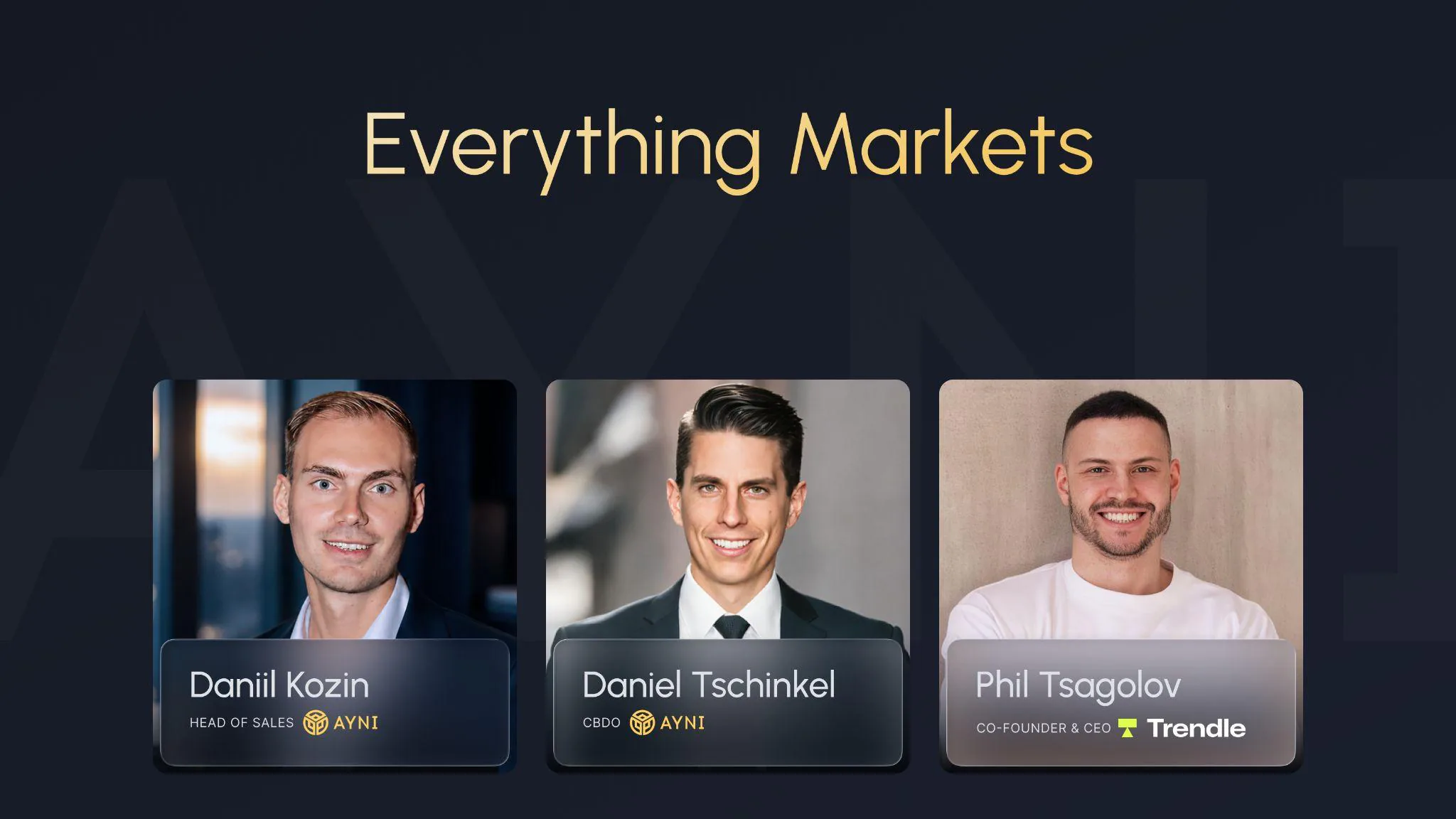
Ayni Gold hosted Everything Markets, a live AMA with Trendle exploring how new kinds of value can become measurable, transparent and usable market products. The conversation connected Trendle’s attention markets with Ayni Gold’s link to physical gold production, covering data integrity, investor behavior and the challenge of building accessible products for users beyond Web3. Watch the full recording on Ayni Gold’s X account.
Payment improvements are part of the product work
We are also simplifying the payment flow. The planned update will reduce the number of steps at checkout, send an immediate payment confirmation, and guide new users directly to account activation. App navigation is being updated alongside it so users can move from onboarding to payment and product access more easily.
Ayni Weekly Briefing
We share weekly updates on gold, tokenized assets, product progress, and the Ayni Gold ecosystem.
Follow the latest briefings on our website, and register in our app to receive future editions directly in your inbox.

More articles
September 15, 2026
Ayni Gold Weekly Briefing: Gold Approaches the Fed Meeting After a Third Weekly Decline
Gold rebounded on Friday but still closed a third straight losing week as August inflation data pushed Fed rate-hike odds to 87%, while Finloop, Aberdeen and Broadridge moved tokenized products closer to existing financial infrastructure.

August 11, 2026
Ayni Gold Weekly Briefing: Gold Breaks Higher as Rate-Hike Bets Recede
Gold surged more than 7% for the week as a weak US payroll report, softer oil prices, and falling bond yields pulled rate-hike bets off the table, while BlackRock expanded its on-chain reserve products and tokenized gold moved in step with the rally.
July 31, 2026
Ayni Gold Weekly Briefing: Gold Finds Its Footing Again
Gold climbed back above $4,000 per ounce and was on track for its first monthly gain in four months as the dollar softened, the Fed held rates amid dissent, and World Gold Council data showed central banks and investors carrying demand while tokenized gold volume already topped 2025's full-year total.